Red-Light Therapy
Top searches for red light therapy include the phrase "is it a hoax." The honest answer is the more useful one: it's neither magic nor a hoax — a narrow, real tool buried under a mountain of marketing. Here's exactly what it does, what it doesn't, and how to dose it so you're not standing in front of a glowing panel hoping.
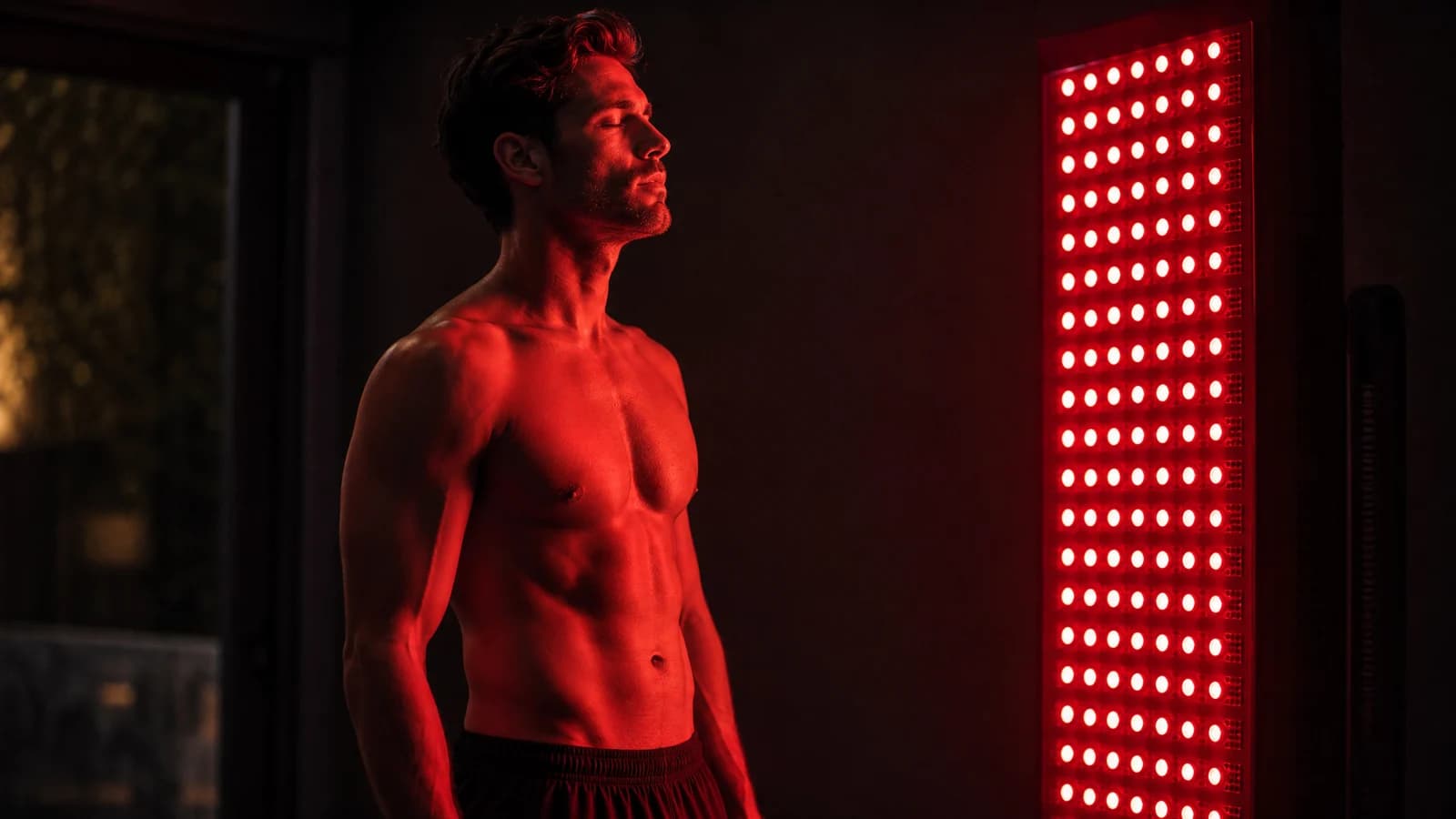
It's 6:40am and you're standing in your underwear in a dark spare room, three feet from a slab of red glass that cost you six hundred dollars. The light is loud — that deep, theatrical crimson that makes your skin look like a darkroom. Your phone is propped against the dresser, timer counting up: 4:11, 4:12, 4:13. You're not sure if it's supposed to be ten minutes or twenty. You're not sure if you should be closer. You read somewhere you shouldn't wear sunglasses, then somewhere else that you should. A man on a podcast — lean, confident, mid-sentence about mitochondria — is the reason this panel is in your house. And you have no idea, none, whether anything is happening to you right now.
Not magic, not a hoax
Here's the truth almost nobody selling you a panel will say plainly: red-light therapy is neither magic nor a hoax. It's a real tool with a short, specific list of things it genuinely does — and a marketing machine that buried that short list under a mountain of everything else. The science is narrower than the ads and broader than the skeptics. Somewhere between "cures everything" and "expensive flashlight" is the actual answer, and it's worth knowing, because the actual answer is the only version you can dose correctly. So before the mechanism, the blunt part: pick what you actually came here for, and find out where it sits on the evidence.
Does it actually work for…?
We graded the most-searched claims against the actual evidence — not the marketing. Pick what you care about. We’ll tell you straight: do it, try it, or skip it.
One of the best-evidenced uses — improves collagen density, fine lines and tone in controlled trials.
Bottom line — Do it. Low dose, near the panel, most days. Patience over power — results show over 8–12 weeks.
Grades reflect the weight of human evidence for typical home-device use. Strong evidence for a use doesn’t guarantee your device, at your dose, delivers it — see the dose calculator. Not medical advice.
Light has an address
It's not mystical. Red (~630–660nm) and near-infrared (~810–850nm) light penetrates a few millimetres into tissue and is absorbed by one specific target: cytochrome c oxidase, Complex IV of the mitochondrial electron transport chain. We know it's that enzyme because the action spectrum of the cellular effects matches its absorption spectrum. 1 Why those wavelengths and not others? Below ~600nm your blood soaks the light up; above ~1100nm water does. Between them sits the "optical window" — the band where light actually gets through skin. Red is shallow (skin, hair); near-infrared reaches deeper (joints, muscle).
The elegant part is what happens next. Under stress or low oxygen, nitric oxide jams onto cytochrome c oxidase and throttles respiration. A photon knocks that inhibitory NO off — electron transport restarts, ATP ticks up, and the released nitric oxide relaxes nearby blood vessels. That's the whole show. It's real — but be honest about scale: most of this chain is best-established in cell culture, and the size of the effect in living tissue is modest. You're not standing in front of medicine. You're standing in front of light with an address.
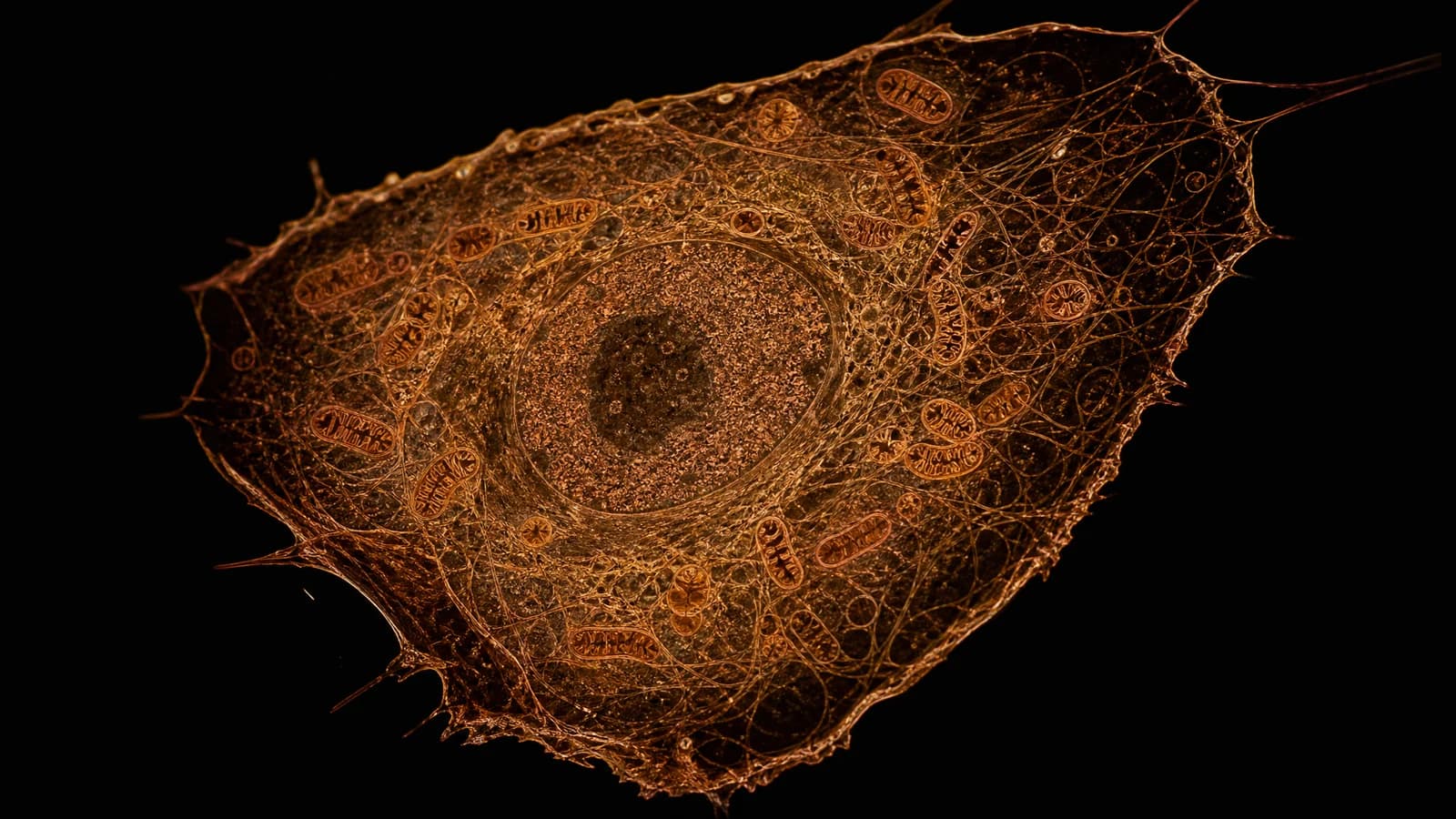
“The primary site of light absorption in mammalian cells has been identified as the mitochondria, and more specifically, cytochrome c oxidase.”
Why more is worse
This is the one fact that separates someone who read the science from someone who read the sales page — and no panel ad prints it. Photobiomodulation follows a biphasic dose response (the Arndt–Schulz curve): too little does nothing, an optimal mid-dose helps, and past the optimum the benefit doesn't plateau — it reverses. 6 Every other tool you own rewards a "more is better" instinct. This one punishes it. Concretely, a few J/cm² at the skin is the helpful range; stand two inches away for forty minutes "to really get it" and you sail past the window into nothing — or worse, into heat. More minutes don't mean more results. They mean you found the ceiling and kept climbing past it.
“A very low dose of light has no effect, a bigger dose has a positive effect until a plateau… increase beyond that point and the benefit progressively decreases, until further increases actually start to have damaging effects.”
The evidence ladder
Climb it honestly and most of the claims fall off. Skin (strong): the best cosmetic case — a controlled trial in ~136 people found red/near-infrared LED improved complexion and ultrasound-measured collagen density. 3 Real, visible, modest — not a facelift. Hair (solid, FDA-cleared): sham-controlled trials show low-level laser beats placebo for density in male-pattern loss 5 — a genuine adjunct to minoxidil/finasteride, a thickener, not a cure. Pain (good): a top-tier Lancet meta-analysis found low-level laser relieved neck pain versus placebo, with relief lasting months. 2 Recovery (moderate): a meta-analysis found light around training cut soreness and damage markers and modestly improved performance. 4
The hype tier
Everything the panel was sold on, and almost nothing it was proven on. Testosterone: the "shine red light on your testicles" claim rests on decades-old animal work — there is no credible human trial. Worse, the testes are heat-sensitive; adding energy there is plausibly counterproductive. Anyone citing a human testosterone result is inventing it. Fat loss / "body contouring": the positive papers are tiny, mostly manufacturer-linked, and a shrinking tape-measure reading is fluid, not verified fat — it doesn't hold. "Detox" and immune-boosting: marketing language, not a mechanism; your liver and kidneys already do this. And remember the regulatory sleight of hand — *FDA-cleared is not FDA-approved. It only means "similar enough to a device that already exists." The gap between what red light is marketed on and what it's proven* on is the widest in the wellness aisle.
Distance, minutes, skin
Three numbers separate a real session from standing in front of a glowing rectangle. Wavelength: 630–660nm for skin and hair, 810–850nm for joints and muscle — good panels output both. Irradiance (mW/cm², the power hitting your skin) and time combine into the only thing that matters: dose. The formula is genuinely simple — dose (J/cm²) = irradiance × minutes × 60 ÷ 1000 — but the trap is that the irradiance on the box is a fantasy measured at zero distance in a dark lab, and light falls off with the square of distance. So set your real numbers and let this work out the minutes — and tell you the moment more light starts working against you.
How long should you actually stand there?
Dose is power × time. Set your panel’s real output and your goal, and this works out the minutes to hit the therapeutic window — and warns you when more light starts working against you.
The number that matters — and almost never the one on the box. Box figures are measured at zero inches in a dark lab; at a real 6 inches most quality panels deliver 20–100. Never metered yours? Assume the lower half.
Comfortable for a daily session.
Real-world irradiance is usually lower than advertised. Dose at the skin isn’t dose at the target tissue — deeper goals lose light to scatter. And the response is biphasic: there’s an optimal window, and overshooting gives you less, not more. A planning guide, not medical advice.
How to buy without getting scammed
The spec sheet is where the lies live. Panel, mask, or bed? A flexible LED mask is best for skin — it sits at a fixed distance so you're actually consistent, and the FDA-cleared ones (Omnilux, CurrentBody) carry the dose the studies used; skip the $40 no-name versions that under-deliver. A panel is the versatile pick — face, hair, joints, recovery in one; buy on third-party-measured irradiance at a stated distance and the right wavelengths, not on LED count. Beds are mostly a spa upsell. For hair, FDA-cleared LLLT caps (Kiierr, iRestore) are a fair adjunct. Ignore the marketing tells: "300 LEDs!" says nothing about delivered dose, "total wattage" is wall-draw not skin-irradiance, and "lux" is a visible-light metric that's meaningless for invisible near-infrared. Buy on measured irradiance and correct wavelengths. Everything else on the box is theatre.
So — is it worth it? For a couple of specific things, genuinely yes. If you're using it for what the evidence supports — skin, hair, a stubborn joint, recovery — and dosing it right, a good panel earns its place in the room. Not as a miracle; as a finishing tool that does a narrow job well. For everything else it was sold on, no — and that money is better spent on the boring foundation the podcast host skipped, because light does nothing for a body that isn't sleeping, training and eating like it means it. Red light is real, small, and worth it — for the man who knows exactly which two things he bought it for, and doesn't expect the third. Stand in front of it on purpose. Or don't stand there at all.
Put the real levers first. The light is the finishing 5%.
Start with sleep →References
- 1Hamblin, M.R. — "Mechanisms and applications of the anti-inflammatory effects of photobiomodulation." AIMS Biophysics, 4(3), 2017. PMID 28748217.
- 2Chow, R.T., Johnson, M.I., Lopes-Martins, R.A.B. & Bjordal, J.M. — "Efficacy of low-level laser therapy in the management of neck pain: a systematic review and meta-analysis of randomised placebo or active-treatment controlled trials." The Lancet, 374(9705), 2009. PMID 19913903.
- 3Wunsch, A. & Matuschka, K. — "A controlled trial to determine the efficacy of red and near-infrared light treatment in patient satisfaction, reduction of fine lines, wrinkles, skin roughness, and increase of intradermal collagen density." Photomedicine and Laser Surgery, 32(2), 2014. PMID 24286286.
- 4Leal-Junior, E.C.P. et al. — "Effect of phototherapy (low-level laser therapy and light-emitting diode therapy) on exercise performance and markers of exercise recovery: a systematic review with meta-analysis." Lasers in Medical Science, 30(2), 2015. PMID 24249354.
- 5Suchonwanit, P., Chalermroj, N. & Khunkhet, S. — "Low-level laser therapy for the treatment of androgenetic alopecia in Thai men and women: a 24-week, randomized, double-blind, sham device-controlled trial." Lasers in Medical Science, 34(6), 2019. PMID 30569416.
- 6Huang, Y-Y., Chen, A.C-H., Carroll, J.D. & Hamblin, M.R. — "Biphasic Dose Response in Low Level Light Therapy." Dose-Response, 7(4), 2009. PMID 20011653.