
Metabolic Energy
You sleep eight hours and you're still flattened by 3pm. That's not a sleep problem — it's a fuel problem, and it's a different machine entirely. Here's how your body actually makes energy, why yours is running on fumes, and the short list of levers that rebuild the engine.
It's 3:14pm. You're staring at a spreadsheet you've read four times, and the numbers won't hold still. You did everything they told you. Eight hours last night — real eight, in bed by ten, no screen. No wine. You have a gym membership you actually use. And still: the slow grey shutdown behind the eyes, the pull toward a fourth coffee you know won't work, the quiet suspicion that something is wrong with you because the inputs are all correct and the output is a man slumped at a desk with the lights on inside and nobody driving. You'll blame your sleep tonight. You'll go to bed earlier. It won't fix it — because it was never the problem. You're not under-rested. You're under-powered. Those are not the same machine.
Two words, two machines
Here's what nobody told you: tired is two different states wearing the same word. One is sleepiness — sleep debt, the heavy-lidded need to lie down. You can pay that off in bed. You did; that account is settled. The other is fatigue — no power, no drive, no output. A car with a full tank and a dead alternator. You can park that car in the garage for a week and it still won't move, because rest was never the missing ingredient. The two genuinely separate in the research — different drivers, different fixes. 1 You fixed your sleep and you're still flat because you've been repairing the wrong machine.
And here's the part that changes everything: energy is not something you rest into. It's something you manufacture. Every watt you ran on today was built — inside your cells, from fuel and oxygen, by machinery you either maintain or neglect. So before the science, the obvious question: which machine is actually yours? Answer honestly and the decoder will point you at the likely culprit — and the one test that settles it.
Why am I so tired all the time?
Fatigue isn’t one thing. Answer eight quick questions and we’ll map your pattern to its most likely driver — and the exact test or move that settles it. Not a diagnosis. A decoder.
Do you wake up unrefreshed, even after enough sleep?
Snoring or breathing in your sleep — any of these? (Tap all that apply)
Do you hit a wall mid-afternoon, especially after a carb-heavy lunch?
Tired but wired — exhausted, yet you can’t switch off or fall asleep?
Any of these? (Tap all that apply)
Lost interest or pleasure in things you used to enjoy — most days, two weeks or more?
Finally — any of these? (These need a doctor, not a calculator)
The engine you have never thought about
Inside almost every cell sit your mitochondria — tiny power plants that take fuel and oxygen and turn them into ATP, the molecule that actually pays for everything you do. Here's the fact that reframes the whole thing: you don't store much ATP. Your body holds barely a couple of ounces of it at any moment and recycles roughly your entire body weight in ATP across a day. Energy isn't a reservoir you dip into. It's a throughput — manufactured on demand, every second, or not at all. A flat afternoon isn't an empty tank. It's a factory running below capacity.
What slows the factory is boringly fixable: inactivity, age, and poor metabolic health all shrink both the number and the quality of your mitochondria. And here is the genuinely good news — the one place you can make a confident claim — you can build more of them. Endurance exercise flips on a master switch (PGC-1α) that tells your muscles to manufacture new mitochondria. We've known this since 1967. 2 Not a supplement. Not a hack. The engine is the one part of you that grows when you ask it to.
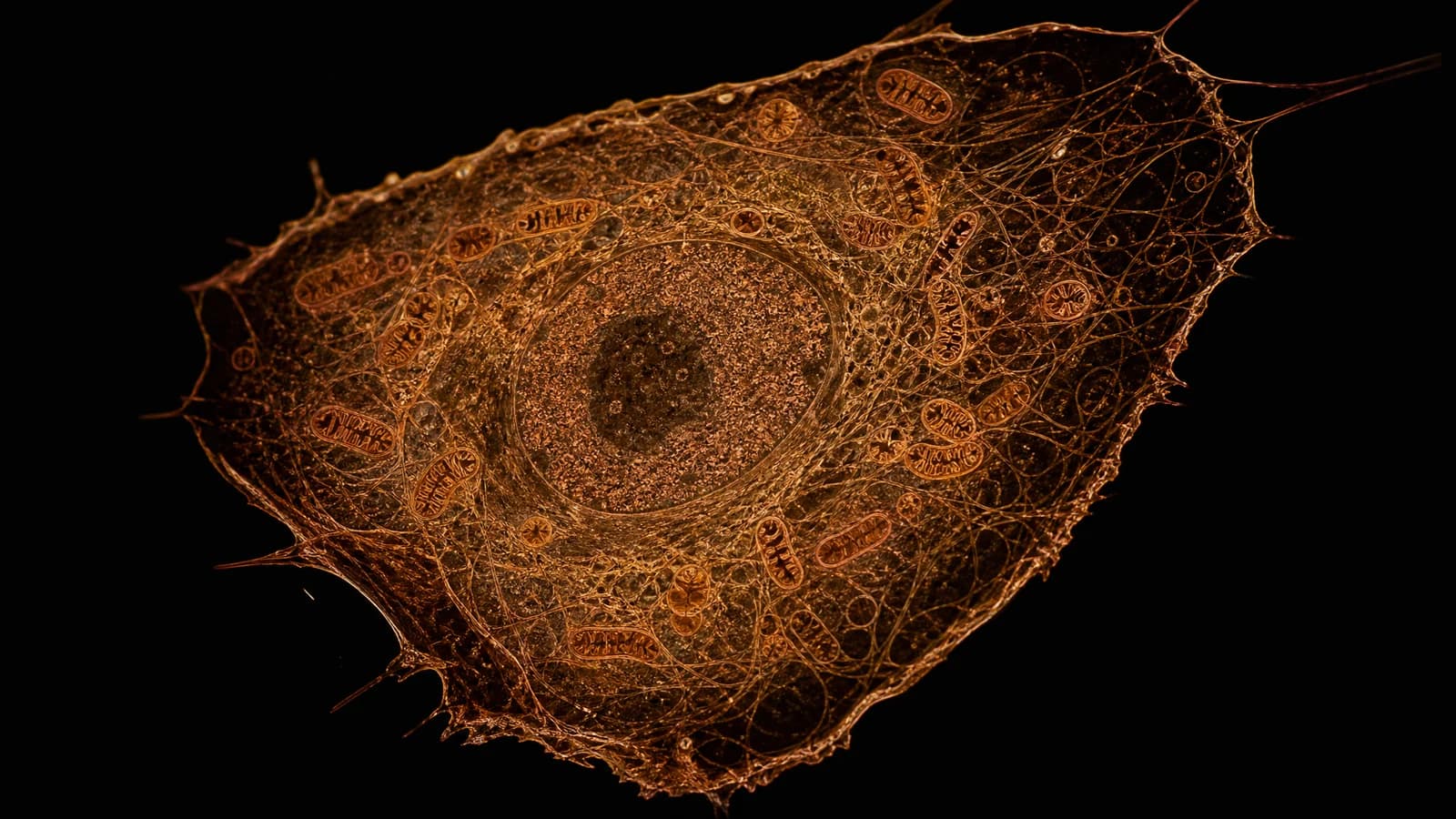
“The mitochondria are the areas in the body where we burn fuels to energy. That is where we burn glucose, where we burn fat, where we burn protein for energy.”
The 3pm crash is a cliff you walk off
That mid-afternoon wall that feels like fatigue is usually a glucose event. A high-carb lunch spikes your blood sugar; insulin overcorrects; an hour or two later you dip — sometimes below where you started — and the bottom of that curve reads as the grey shutdown. It's not a character flaw. It's a blood-sugar cliff, and you walk off it at the same time every day. The twist the labs keep confirming: the same meal spikes different people wildly differently — your crash food isn't your colleague's. 3
You can stop guessing and watch it happen. A continuous glucose monitor for two weeks is the cheapest education in your own metabolism there is — wear it, learn which three meals flatten you, then cancel; that's a feature, not a failure. One honest caveat, because it matters: persistent tiredness after eating — especially with thirst, weight change, or a family history — is a screening flag, not a thing to biohack. Ask for an HbA1c. Don't optimise a symptom that's trying to tell you something. 4
Tired but wired
Your energy runs on a daily cortisol rhythm: it should spike in the first half-hour after you wake, then slide down all day to a floor near midnight. That curve is the difference between sharp-in-the-morning and dead-at-noon. Run it backwards — flat when you should be alert, electric when you should be winding down — and you get the state everyone recognises and no one can name: tired but wired. A flattened cortisol slope is one of the most reliable stress-physiology markers of feeling like garbage. 5
Two honest notes. First, the fix for the rhythm is mostly light and timing, not a supplement — morning daylight is the cheapest cortisol intervention there is. Second: "adrenal fatigue" is not a real diagnosis. A systematic review of 58 studies found nothing behind it. 6 The adaptogen stacks sold to fix your "burnt-out adrenals" are a cure for a condition you don't have. Real HPA-axis dysregulation exists; so does genuine adrenal disease. The supplement-aisle version is marketing.
Get your bloods before you buy anything
Here is the most responsible sentence in this piece: a lot of "I'm just tired all the time" is a number on a blood panel nobody ran. The usual suspects, all common, all correctable, all missed. Low iron — your ferritin can be on the floor and cause real fatigue before you're ever technically anaemic; correcting it in iron-deficient people genuinely lifts energy. 7 B12 and vitamin D, both quietly low in a lot of men. A sluggish thyroid, caught with a single TSH. And the big one nobody suspects: undiagnosed sleep apnea — you "sleep eight hours," but you stop breathing dozens of times an hour and never reach deep sleep, so you wake wrecked. It's roughly twice as common in men and the majority of cases are never caught. 8 If you snore and wake unrefreshed no matter the hours, that's a sleep study, not another scoop of powder.
Brain fog rides shotgun with all of it — and it's real, not in your head. Inflammatory signalling literally tells the brain to slow down (the same machinery behind feeling foggy when you're sick), which is why glucose swings, bad sleep and low-grade inflammation all show up as the same mental haze. 9 The move is simple and almost nobody makes it: before you spend a cent on supplements, get one panel — ferritin, full blood count, B12, vitamin D, TSH, HbA1c. Most male fatigue is hiding in those six lines.
What actually moves the needle
Now the part you came for — ranked, honestly, by how much each one actually changes your output. Start at the top. The boring stuff is the powerful stuff, and if you skip it to reach for the exciting stuff you're bolting a spoiler onto a car with no engine.
Zone-2 cardio — build the engine
The single best energy lever that exists. Easy, conversational aerobic work — the pace where you can talk but not sing — is the exact stimulus that builds more mitochondria. Roughly 150–180 minutes a week, in three or four sessions. It's slow, unglamorous, and it raises your baseline energy for weeks, not hours. Nothing else on this list comes close. If you're going to train it, train it for real — your wrist HR lies during steady cardio, so a chest strap is the cheap upgrade that makes it honest.
Grade: A+. Find your range below.
The heart rate that builds your engine
Zone 2 is the pace where your body builds mitochondria — the cellular engines that make energy. It feels almost too easy. That’s the point. Set your age for your range.
Estimated max HR 185 bpm · 211 − 0.64 × age
The talk test beats any formula. In zone 2 you can hold a full conversation in complete sentences — but you’d struggle to sing. Gasping means you’ve drifted into zone 3; ease off. The methods disagree by a few beats — that’s normal. Aim for the overlap and let how it feels fine-tune the number.
Estimates from population averages — your true max could be 10–15 bpm either side, and beta-blockers shift everything. Three to four sessions a week, 30–45 minutes each, is where the payoff lives.
Light, rhythm and a glucose-stable plate
Free, and they fix the crashes the engine can't. Morning daylight within an hour of waking, plus a consistent wake time, anchors the cortisol rhythm — this is what kills the wired-at-night, flat-at-noon pattern. On the plate: a protein-forward breakfast (30–40g, not a cereal-and-juice sugar bomb), eat your protein and veg before the carbs, and take a ten-minute walk after lunch — the single most underrated trick there is, because working muscle soaks up glucose and flattens the cliff before you reach it.
Grade: A. The post-lunch walk alone is worth it.
Creatine, smart caffeine, magnesium
On a solid base, these are real. Creatine, 3–5g a day — not just a gym supplement; it fuels the rapid-energy system in every cell including your brain, and the cognition-under-fatigue data is genuinely strong. The cheap monohydrate tub and the premium one are the same molecule. Caffeine works — the problem is timing: delay your first cup 60–90 minutes after waking, and set a hard afternoon cutoff so it's cleared by lights-out (the tool below finds your number). Magnesium glycinate, 200–400mg in the evening if your sleep or bloods say so.
Grade: B+. Real, but they amplify the foundation — they don't replace it.
How late can your last coffee be?
Caffeine’s half-life is ~5–6 hours, so it lingers. Set your dose and bedtime, and this works back to the latest you can drink and still be mostly clear by lights-out.
This pushes your cutoff into the early afternoon. Front-load your caffeine.
Peptides — the last few percent
This tier is for men who've genuinely nailed everything above and want the final edge — and it's honest about the evidence being early. MOTS-c is a mitochondrial-derived peptide that mimics some effects of exercise in animal models; the mechanism is exciting, the human data thin, and it does not replace zone-2. NAD+ and its precursor NMN raise the coenzyme your mitochondria run on, which declines with age — the bloodwork moves; the felt effect is subtle. Interesting, not magic. Earn the foundation first.
Grade: C+. Mechanisms are real; human proof is early.
The compounds at the edge of metabolic energy — for when the foundation is already built:



“Life is zone 1, zone 2, and zone 5.”
Skip these — they only sell hope
Where not to spend your money, because none of it survives contact with the evidence. "Adrenal fatigue" stacks — fixing a condition you don't have. B12 shots and "energy" IV drips if you're not actually deficient — you'll make expensive urine; get tested first. "Energy" gummies and B-vitamin energy drinks — it's the caffeine and sugar doing the work, minus the crash insurance. Mega-dose multivitamins and "detox" teas — your liver already does this for free. Nootropic "energy" blends — proprietary pixie dust; it's always just the caffeine. Earn your energy from the bottom up. Zone-2, light, stable glucose and the bloods that catch a real deficiency will do more than any vial — and they make the good supplements actually work.
So stop going to bed earlier to fix a problem that doesn't live in your bed. The flatness you feel at 3pm isn't a verdict — it's a readout, telling you the furnace, the fuel and the rhythm have been left to idle for years while you obsessed over the one input that was already handled. Every part of it responds. The furnace re-lights, the fuel curve smooths, the rhythm resets. None of it is fast and none of it comes in a single pill — but all of it is yours to build. Build the engine first. The edge comes last.
Build the metabolic stack tuned to your numbers and your goal.
Engineer your protocol →References
- 1Shen, J., Barbera, J. & Shapiro, C.M. — "Distinguishing sleepiness and fatigue: focus on definition and measurement." Sleep Medicine Reviews, 10(1), 2006. PMID 16376590.
- 2Holloszy, J.O. — "Biochemical adaptations in muscle: effects of exercise on mitochondrial oxygen uptake and respiratory enzyme activity." Journal of Biological Chemistry, 242(9), 1967. The origin of the exercise-mitochondria field; PGC-1α later identified as the master regulator of biogenesis.
- 3Zeevi, D. et al. — "Personalized Nutrition by Prediction of Glycemic Responses." Cell, 163(5), 2015. PMID 26590418. 800 people, CGM: postprandial glucose responses are highly individual.
- 4American Diabetes Association — Standards of Care in Diabetes (updated annually). HbA1c ≥6.5%, fasting glucose ≥126 mg/dL = diabetes; HbA1c 5.7–6.4% = prediabetes.
- 5Adam, E.K. et al. — "Diurnal cortisol slopes and mental and physical health outcomes: a systematic review and meta-analysis." Psychoneuroendocrinology, 83, 2017. PMID 28578301. Flatter slope linked to worse health.
- 6Cadegiani, F.A. & Kater, C.E. — "Adrenal fatigue does not exist: a systematic review." BMC Endocrine Disorders, 16:48, 2016. PMID 27557747.
- 7Verdon, F. et al. — "Iron supplementation for unexplained fatigue in non-anaemic women: double-blind randomised placebo-controlled trial." BMJ, 326:1124, 2003. PMID 12763985.
- 8Peppard, P.E. et al. — "Increased prevalence of sleep-disordered breathing in adults." American Journal of Epidemiology, 177(9), 2013. PMID 23589584.
- 9Dantzer, R. et al. — "From inflammation to sickness and depression: when the immune system subjugates the brain." Nature Reviews Neuroscience, 9, 2008. PMID 18073775.